Definitional answer
What Is Palworld Breeding Power?
Palworld breeding power is a hidden numerical value assigned to each Pal species. When two parent Pals breed through the normal system, the game combines their breeding power values to create a target number. The child Pal is usually the valid Pal whose value is closest to that target.
This number is the reason two specific Pals create a predictable offspring instead of a random child. It is also why many different parent combinations can produce the same target Pal. A Palworld breeding calculator uses these values to show parent-to-child results, child-to-parent reverse lookup, breeding combinations, breeding charts, and chain breeding routes.
Breeding Power vs Breeding Value, BPower, BPV, and CombiRank
Players and calculators use several names for the same concept. Some call it breeding power. Others call it breeding value, breeding rank, BPower, BPV, or CombiRank. The label changes, but the purpose is the same: it is the hidden number used to calculate normal offspring results.
| Term | Meaning |
|---|---|
| Breeding Power | Common player-facing term for the hidden value. |
| Breeding Value | SEO-friendly alternate name often used in guides. |
| Breeding Rank | Table or calculator label for the same value. |
| BPower / BPV | Short form meaning Breeding Power or Breeding Power Value. |
| CombiRank | Technical mechanics term used by several calculator tools. |
How the Palworld Breeding Power Formula Works
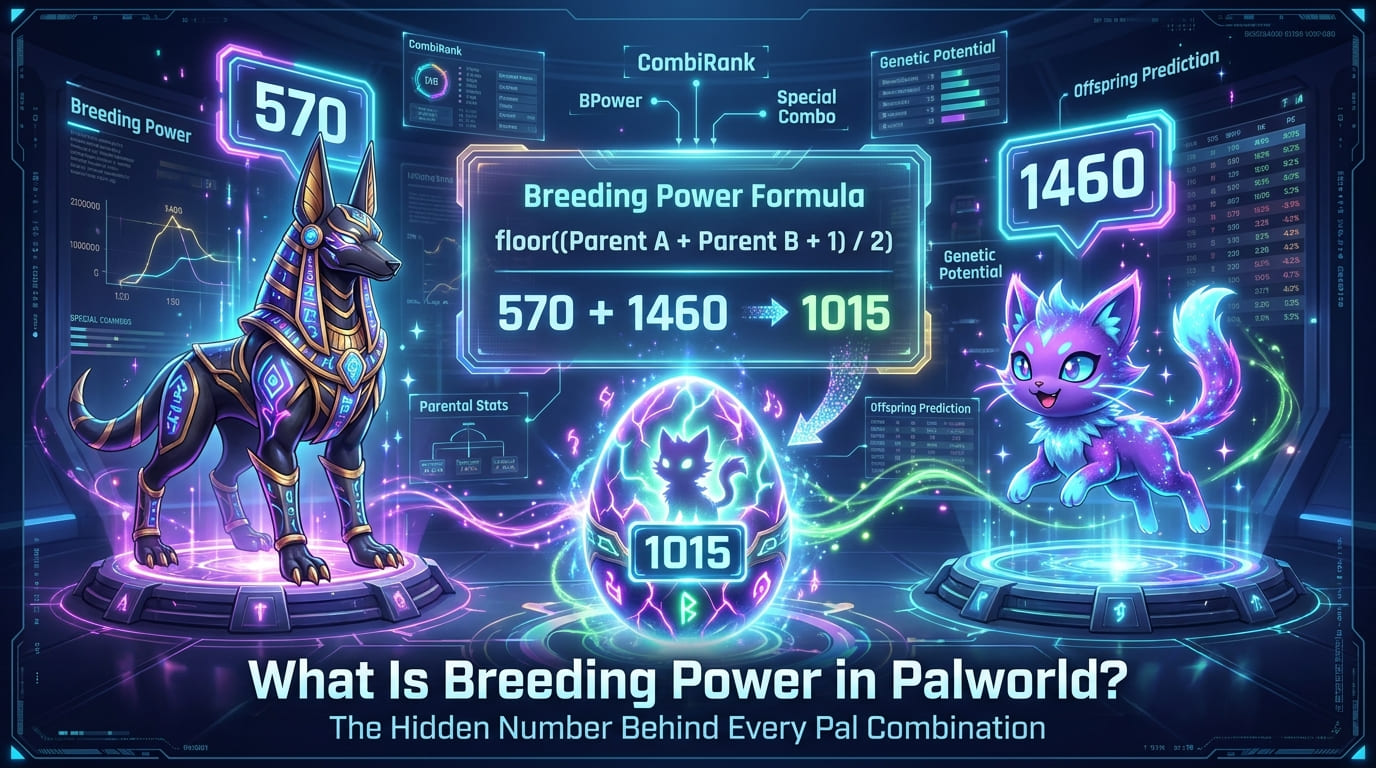
For normal parent pairs, the system takes the breeding power of Parent A and Parent B, adds them together, adds 1, divides by 2, and rounds down using the floor function. The result is a target value. The game then maps that target to the nearest valid child Pal.
Standard Breeding Power Formula
target = floor((Parent_A_Power + Parent_B_Power + 1) / 2)
After calculating the target, the game chooses the Pal whose breeding power is closest to that target, unless a special breeding combo overrides the normal formula.
Worked Example With Real Numbers
Suppose Parent A is Anubis with breeding power 570, and Parent B is Cattiva with breeding power 1460. The target number is:
floor((570 + 1460 + 1) / 2) = floor(2031 / 2) = 1015
The calculator then checks the breeding database for the nearest valid child value. If one Pal is at 1010 and another is at 1020, both are close, so internal ordering or game data rules can decide the final result. This is why calculators are useful: they already store the valid child mapping.
Why Lower Breeding Power Usually Means Rarer Pals
Breeding power is not a strength score. A smaller number does not mean a Pal is weak. In fact, many rare, legendary, or late-game Pals have lower values. Common early-game Pals usually sit near the high end of the table.
The key is the midpoint. Breeding two very common Pals tends to produce another high-value common Pal. Breeding one very low-value Pal with one high-value Pal often creates a middle-value result. Breeding two low-value Pals usually keeps the target closer to the rare end of the table, unless a special combo changes the outcome.
High Value
Usually common Pals such as Chikipi, Teafant, Mau, Lamball, and Cattiva.
Middle Value
Often mid-game Pals, utility Pals, and many standard breeding results.
Low Value
Usually rare, legendary, fusion, or late-game Pals such as Jetragon, Shadowbeak, and Blazamut.
When Special Breeding Combos Override Breeding Power
Breeding power controls normal breeding results, but it does not explain every outcome. Some unique parent combinations are special cases. These combinations produce a fixed child Pal, even if the breeding power formula would suggest a different result.
This is why a simple manual calculation can disagree with a good calculator. A strong Palworld breeding calculator checks special combos first, then applies the normal breeding power formula. Special combos are especially important for Fusion Pals, variants, and fixed breeding results.
- Normal result: parent values create a target value, then the nearest Pal is selected.
- Special combo: a fixed child result overrides the usual breeding power calculation.
- Calculator role: detect special combinations before showing the final offspring.
How a Palworld Breeding Calculator Uses Breeding Power
The formula is simple, but the full system is not. A calculator stores every Pal value, variant, special combo, and child result so players do not have to test hundreds of parent pairs manually. This supports both basic breeding and advanced planning.
Parent-to-Child Lookup
Select two parent Pals and see the expected child Pal result instantly.
Child-to-Parent Lookup
Select a target child Pal and find all possible parent combinations.
Breeding Chart
Compare breeding values, parent pairs, child results, and special combo notes.
Chain Breeding
Use intermediate Pals to build a path toward rare Pals or desired passive skills.
Breeding Power vs Passive Skill Inheritance
Breeding power determines the species result. It does not guarantee passive skills, IVs, or perfect traits. Passive skills are a separate inheritance layer. Parent Pals can pass down traits, but the final passive set may include unwanted skills or miss a trait you wanted.
Use breeding power to choose the correct child Pal. Then use clean parents, repeated eggs, and chain breeding to improve passive skill inheritance. For combat builds, focus on attack and survival traits. For base workers, prioritize work speed and work suitability. For mounts, movement speed and stamina usually matter most.
Full Palworld Breeding Power Value Table
Use this searchable table to compare Palworld breeding power values. It includes the current 113+ Pal value set used for breeding mechanics reference. Search by Pal name, filter by value band, or sort by the breeding power column.
| Pal Name | Breeding Power | Value Band |
|---|
Why Your Breeding Power Result Looks Wrong
If your manual formula does not match a calculator or in-game result, check four things. First, confirm the exact Pal variant. Second, make sure the calculator database is current. Third, check whether the pair is a unique breeding combination. Fourth, reset filters if parent combinations or child results are hidden.
The most common mistake is treating breeding power as the only rule. It is the main rule for normal pairs, but special combos, variants, and updated database logic can change the final result.
FAQs
What is breeding power in Palworld?
Breeding power in Palworld is a hidden number assigned to each Pal species. When two normal parent Pals breed, their values are averaged into a target number, then the game chooses the closest valid child Pal.
How does Palworld breeding power work?
Palworld breeding power works by combining the two parent values with the formula floor((Parent A + Parent B + 1) / 2). The child is usually the valid Pal with the closest breeding power to that target.
Is breeding power the same as CombiRank in Palworld?
Yes, many calculators use CombiRank, BPower, BPV, breeding rank, or breeding value to describe the same hidden species number. The names vary, but they all explain how normal parent combinations determine the child Pal.
Does lower breeding power mean rarer Pals?
In general, lower breeding power values are associated with rarer or stronger Pals, while higher values are common early-game Pals. However, the child result depends on the calculated target value and special combo exceptions.
Why does breeding power not match my breeding result?
Breeding power may not match your result if the pair is a special breeding combo, a Pal variant was selected incorrectly, the calculator data is outdated, or active filters hide the correct child or parent combination.
Does breeding power affect passive skills in Palworld?
Breeding power mainly determines the child Pal species, not guaranteed passive skills. Passive traits are inherited separately, so players still need clean parents and repeated eggs when chasing perfect combat, worker, or mount passives.
Use Breeding Power Without Doing the Math
Open the Palworld Breeding Calculator to find child results, parent combinations, breeding charts, special combos, and chain breeding routes instantly.
Open the Calculator