Quick answer
How Does Palworld Breeding Work?
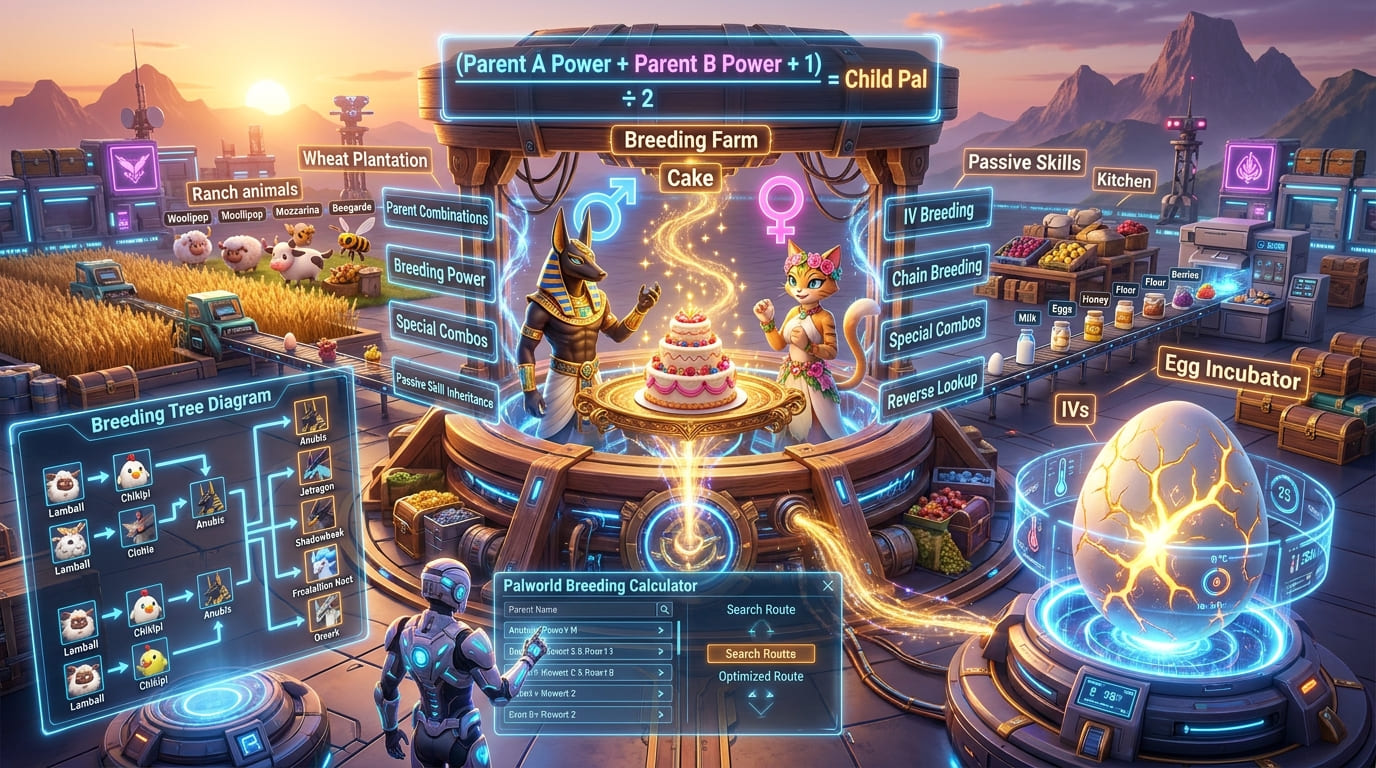
Palworld breeding works by placing one male Pal and one female Pal inside a Breeding Farm, adding Cake to the facility, waiting for the pair to produce an egg, and hatching that egg in an Egg Incubator. The child Pal is not random in the simple sense. It is determined by the parent combination, hidden breeding power values, special breeding combos, Pal variants, and sometimes exception rules.
For players, breeding has three major purposes. First, it lets you get new Pals without relying only on wild captures. Second, it helps you create specific Pals through parent combinations and reverse lookup. Third, it gives you a way to plan better passive skills, cleaner traits, IV inheritance, combat builds, worker builds, mount builds, and rare Pal routes.
What You Need Before Breeding Pals
Before you can breed Pals, you need the correct structure, the correct parents, and a stable Cake supply. The system is simple once it is built, but many failed breeding attempts happen because one requirement is missing.
Required Structure
You need a Breeding Farm. This is the structure where two parent Pals are assigned to produce eggs.
Required Parents
You need one male Pal and one female Pal. The parent species and variants affect the child result.
Required Resource
You need Cake. Without Cake placed in the Breeding Farm, egg production will not continue.
Required Hatching Setup
You need an Egg Incubator to hatch the egg and receive the child Pal.
How to Set Up the Breeding Farm
The Breeding Farm is the center of the Palworld breeding system. It unlocks at level 19 and requires building materials before you can assign parent Pals. Once built, it acts as the controlled space where two Pals generate eggs.
| Breeding Farm Requirement | Details | Why It Matters |
|---|---|---|
| Unlock Level | Level 19 | You need the structure before any breeding route can begin. |
| Materials | Wood x100, Stone x20, Fiber x50 | Prepare materials before planning large breeding projects. |
| Parent Assignment | One male Pal and one female Pal | The two parents determine the egg result and possible traits. |
| Production Resource | Cake placed in the facility | Egg production requires Cake in the Breeding Farm box. |
- Reach the required level and unlock the Breeding Farm technology.
- Collect Wood, Stone, and Fiber for construction.
- Build the Breeding Farm in a clear area of your base.
- Assign one male Pal and one female Pal to the farm.
- Place Cake in the Breeding Farm’s Cake box.
- Wait for breeding progress, collect the egg, and move it to an Egg Incubator.
If your Pals are not breeding, the issue is usually one of four things: both Pals are not assigned, both parents are not opposite sexes, Cake is missing, or the Breeding Farm placement is causing pathing problems. For large breeding projects, place the farm somewhere open and easy to access.
How Cake Works in Palworld Breeding
Cake is the required breeding resource. Many players build the Breeding Farm correctly, assign two Pals, and still get no egg because Cake is missing. Cake must be placed in the Breeding Farm facility, not simply stored somewhere else in the base.
Cake Recipe Details
| Ingredient | Amount | Common Production Source |
|---|---|---|
| Flour | x5 | Wheat Plantation plus Mill |
| Red Berries | x8 | Berry Plantation or Ranch production |
| Milk | x7 | Mozzarina in a Ranch |
| Egg | x8 | Chikipi in a Ranch |
| Honey | x2 | Beegarde in a Ranch |
For one or two eggs, manually producing Cake is fine. For serious breeding, build a Cake supply chain: Wheat Plantation, Mill, Berry production, Ranch Pals for Milk, Eggs, and Honey, and a Cooking Pot or higher-level stove. This turns breeding from a slow manual process into a repeatable system.
How Eggs and Incubation Work
Once the parent Pals are assigned and Cake is available, the Breeding Farm produces an egg over time. That egg must be moved to an Egg Incubator to hatch. The hatched Pal is the child result of the parent combination, but traits and stats may vary depending on inheritance.
This matters because breeding has two layers. The first layer is the species result: which child Pal comes from the parents. The second layer is quality: passive skills, IVs, work suitability, and build potential. A Palworld breeding calculator helps with the first layer and can also support planning for the second layer if it includes passive skill, IV, or chain breeding tools.
How the Child Pal Is Determined
The child Pal is usually determined by hidden breeding power values. Every Pal has a breeding power value, also called CombiRank by many calculators and guides. For standard pairs, the system calculates a target value from the two parents and then chooses the nearest valid child Pal in the standard breeding pool.
Breeding Power Formula
For normal parent pairs, the common calculator formula is:
target = floor((Parent_A_Power + Parent_B_Power + 1) / 2)
The child is usually the valid Pal whose breeding power is closest to the target value. Lower breeding power values are generally associated with rarer Pals.
Real Number Example
Suppose Parent A is Anubis with breeding power 570 and Parent B is Cattiva with breeding power 1460. The target is calculated like this:
floor((570 + 1460 + 1) / 2) = floor(2031 / 2) = 1015
The calculator then looks for the nearest valid child result. If Robinquill has breeding power 1020 and Felbat has breeding power 1010, both are 5 points away from the target. In this kind of tie, internal ordering can decide the final result.
This explains why the child result is not always the exact midpoint number. The formula produces a target, then the game maps that target to a valid Pal. That is why calculators are useful: they already know the breeding database, the nearest matches, and the special exceptions.
Special Breeding Combos and Unique Results
Not every breeding result follows the normal breeding power formula. Some parent pairs are special breeding combos that produce a fixed child Pal. These unique combinations can override normal formula-based expectations.
For example, a special combo can act like a shortcut to a fusion Pal or variant result. In those cases, the calculator should check special combo logic first, before applying the standard breeding power average. This is why two calculators may appear to disagree if one has updated special combo data and the other only uses a basic formula.
Why Special Combos Matter
- They can create fixed offspring results.
- They may produce fusion Pals or variants.
- They can override normal breeding power calculations.
- They are easy to miss in old breeding charts.
- They are a common reason for “wrong breeding result” confusion.
How Parent Combinations Work
A parent combination is the pair of Pals used to create a child Pal. You can think about parent combinations in two directions. Parent-to-child means you choose two Pals and ask, “What will they make?” Child-to-parent means you choose a target Pal and ask, “What two Pals can make this?”
| Search Method | Best Use | Example Question |
|---|---|---|
| Parent-to-child lookup | Checking a pair you already own | What child do these two Pals produce? |
| Child-to-parent lookup | Breeding a specific target Pal | What parent combinations produce Anubis? |
| Chain breeding | Building a multi-step route | How do I reach this Pal through intermediate Pals? |
| Passive route planning | Moving desired traits through generations | How do I pass down better skills? |
For most players, child-to-parent lookup is the most useful method. Instead of randomly testing breeding combos, enter the child Pal you want into a calculator and review all possible parent combinations. This is the fastest way to plan rare Pal breeding, perfect Pal breeding, and Paldex completion.
How to Breed a Specific Pal
To breed a specific Pal, start with the target child instead of the parents. This prevents random guessing and helps you identify the easiest route from your current Palbox.
- Open the Palworld breeding calculator.
- Choose the target child Pal you want to breed.
- Review all possible parent combinations.
- Check which pairs you already own.
- Compare passive skills and unwanted traits on each parent.
- Confirm whether the pair is a normal formula result or a special combo.
- Assign one male and one female Pal to the Breeding Farm.
- Add Cake, collect the egg, and hatch it in an Egg Incubator.
This process works for popular breeding goals such as Anubis, Jetragon, Frostallion Noct, Shadowbeak, Orserk, Grizzbolt, Jormuntide, Jormuntide Ignis, Blazamut, Lyleen, and other rare or high-value Pals. Use examples sparingly on a mechanics page, but include them where they clarify how the system works.
How Passive Skill Inheritance Works
Passive skill inheritance is one of the biggest reasons players breed instead of only capturing wild Pals. Passive skills can affect attack, defense, movement speed, stamina, work speed, work suitability, and other performance areas. A good breeding route can turn an ordinary Pal into a strong combat Pal, fast mount, or efficient base worker.
However, passive inheritance is not perfectly guaranteed. Parent Pals can pass down desired traits, but unwanted passive skills may also appear. This is why experienced players use “clean parents” with fewer bad traits. The cleaner the parent pool, the easier it is to control the child’s passive skill result.
Passive Skill Planning by Goal
Combat Builds
Prioritize attack, defense, element damage, and survivability traits.
Base Worker Builds
Prioritize work speed, work suitability, sanity support, and utility passives.
Mount Builds
Prioritize movement speed, stamina, and traits that improve travel performance.
A passive skill calculator can help organize the plan, but you should still expect repeated eggs when chasing a perfect trait set. Breeding is a probability-driven optimization system, not a single-click guarantee.
IV Breeding, Stat Inheritance, and Perfect Pals
Advanced players also care about IV breeding and stat inheritance. IVs, potential, and inherited stats can influence how strong a Pal becomes in combat, work, or utility roles. If you are building a perfect Pal, you need to think beyond species result. You need the right Pal, the right passive skills, and the right stat foundation.
IV planning matters most when you are optimizing a small number of high-value Pals. For casual progression, species result and useful passives may be enough. For endgame breeding, IVs and passive traits become part of the same long-term route.
How Chain Breeding and Breeding Trees Work
Chain breeding is a multi-step route where one child Pal becomes a parent for the next breeding step. It is useful when the direct parent pair is hard to get, when a target Pal has limited routes, or when you need to move passive skills through several generations.
A breeding tree shows this route visually. For example, Parent A and Parent B may create Intermediate Pal 1. Intermediate Pal 1 then breeds with Parent C to create your target child Pal. If you are moving passive skills, you may repeat the process until the final child has the right trait set.
When to Use Chain Breeding
- When you do not own the direct parents for a target Pal.
- When you want to transfer passive skills across species.
- When you need a shorter or easier route to a rare Pal.
- When you are planning perfect Pal breeding.
- When you want to avoid catching several difficult parent Pals.
How a Palworld Breeding Calculator Helps
A calculator turns the breeding system into a searchable planning tool. Instead of testing every pair manually, you can calculate offspring, find parent combinations, use reverse breeding search, check a breeding chart, plan chain breeding, and compare routes before spending Cake.
Parent Calculator
Select two parent Pals and see the child Pal result instantly.
Child Calculator
Select a target child Pal and find every possible parent combination.
Breeding Chart
Review breeding combinations, variants, and special combo notes.
Chain Breeding Tool
Find intermediate Pals and plan the shortest breeding path.
Use the calculator whenever you are unsure about a result, planning a rare Pal, trying to pass down passive skills, or checking whether an old breeding chart is still accurate in 2026.
Common Palworld Breeding Mistakes
- Building the Breeding Farm but forgetting Cake.
- Putting Cake in general storage instead of the Breeding Farm box.
- Assigning two Pals of the same sex.
- Using the wrong Pal variant in a calculator.
- Ignoring special combos and unique breeding combinations.
- Expecting passive skills to pass down perfectly every time.
- Using outdated breeding charts after major updates.
- Not using reverse lookup when breeding for a specific Pal.
- Planning a breeding tree without enough Cake production.
Breeding Mechanics Content Network
This page is the main mechanics pillar for the Breeding Mechanics & System silo. Use the supporting pages below to go deeper into each part of the breeding system.
Palworld Breeding Calculator
Calculate parent combinations, child results, and breeding routes.
Palworld Breeding Calculator Guide
Learn how to use every calculator feature step by step.
Palworld Breeding Chart
View breeding combinations and parent-child relationships.
Parent Combinations Guide
Find which parent pairs create your target child Pal.
Chain Breeding Guide
Plan intermediate routes, breeding trees, and shortest paths.
Passive Skill Inheritance
Understand how traits move through parent Pals and offspring.
FAQs
How does Palworld breeding work?
Palworld breeding works by assigning one male Pal and one female Pal to a Breeding Farm with Cake. They produce an egg, which hatches into a child Pal determined by parent combinations, breeding power, special combos, and inherited traits.
What do you need to breed Pals in Palworld?
You need a Breeding Farm, one male Pal, one female Pal, Cake, and an Egg Incubator for hatching. The Breeding Farm is where parents create eggs, while Cake acts as the required breeding resource for each egg.
How is the child Pal determined in breeding?
For normal pairs, the game uses parent breeding power values to calculate a target result, then selects the nearest valid child Pal. Special breeding combos can override this formula and produce a fixed unique offspring instead.
How does Cake work in Palworld breeding?
Cake is required for breeding progress. Place Cake in the Breeding Farm box after assigning one male and one female Pal. Without Cake, the pair will not produce an egg, even if both parents are assigned correctly.
How do passive skills pass down in Palworld?
Passive skills can be inherited from parent Pals, but the final trait set is not guaranteed. Players usually breed cleaner parents with fewer unwanted passives, then use chain breeding to move desired combat, work, or movement traits.
Why is my Palworld breeding result different?
A different breeding result usually comes from outdated data, wrong Pal variants, special combo overrides, gender-specific exceptions, or active calculator filters. Recheck exact parent names, refresh the calculator, and confirm whether a unique combination applies.
Plan Breeding With the Palworld Breeding Calculator
Use the calculator to check parent combinations, child Pal results, reverse lookup routes, chain breeding paths, special combos, and passive skill planning before using Cake in-game.
Open the Calculator